Global Price Reporting Agency (PRA) & commodity intelligence platform
Procurement Advantage
Accurate & transparent market pricing
Real-time elastomer spot market assessments
Predictive AI-powered forecasting
Reduced data lag & greater market transparency
Global Price Reporting Agency (PRA) & commodity intelligence platform
Price Assessments of
THE PROBLEM WE SOLVE
Elastomers price data built for people who have real money on the line
Reduce Input Costs
Compare prices across global markets. Source smarter. Spend less. Every procurement cycle.
Stay Ahead with Trends
Our price assessments built on real bids, offers, and confirmed transactions, not models, not estimates — they give every party in the trade a credible, auditable reference point.
$100bn+
Annual elastomers trade
1%
Better pricing accuracy
$ Millions
Potential savings
WHAT WE OFFER
Comprehensive pricing intelligence in one platform
Historical Prices
Decades of extensive historical price data reveal the recurring cycles, seasonal shifts, and compounding cost drivers shaping global synthetic rubber and elastomer price trends
Current Trends
Real-time spot market pricing shows not only where elastomer and rubber costs stand today, but where they are heading, supported by an advanced commodity intelligence platform that monitors global markets.
Comparisons
Evaluate prices across international markets, make more informed sourcing decisions, and reduce costs throughout every procurement cycle.
Forecast
Use short-term outlooks to guide immediate decisions and long-term projections to support strategic polymer and elastomer procurement planning
WHAT WE COVER
Every rubber that trades. Every grade
that matters.
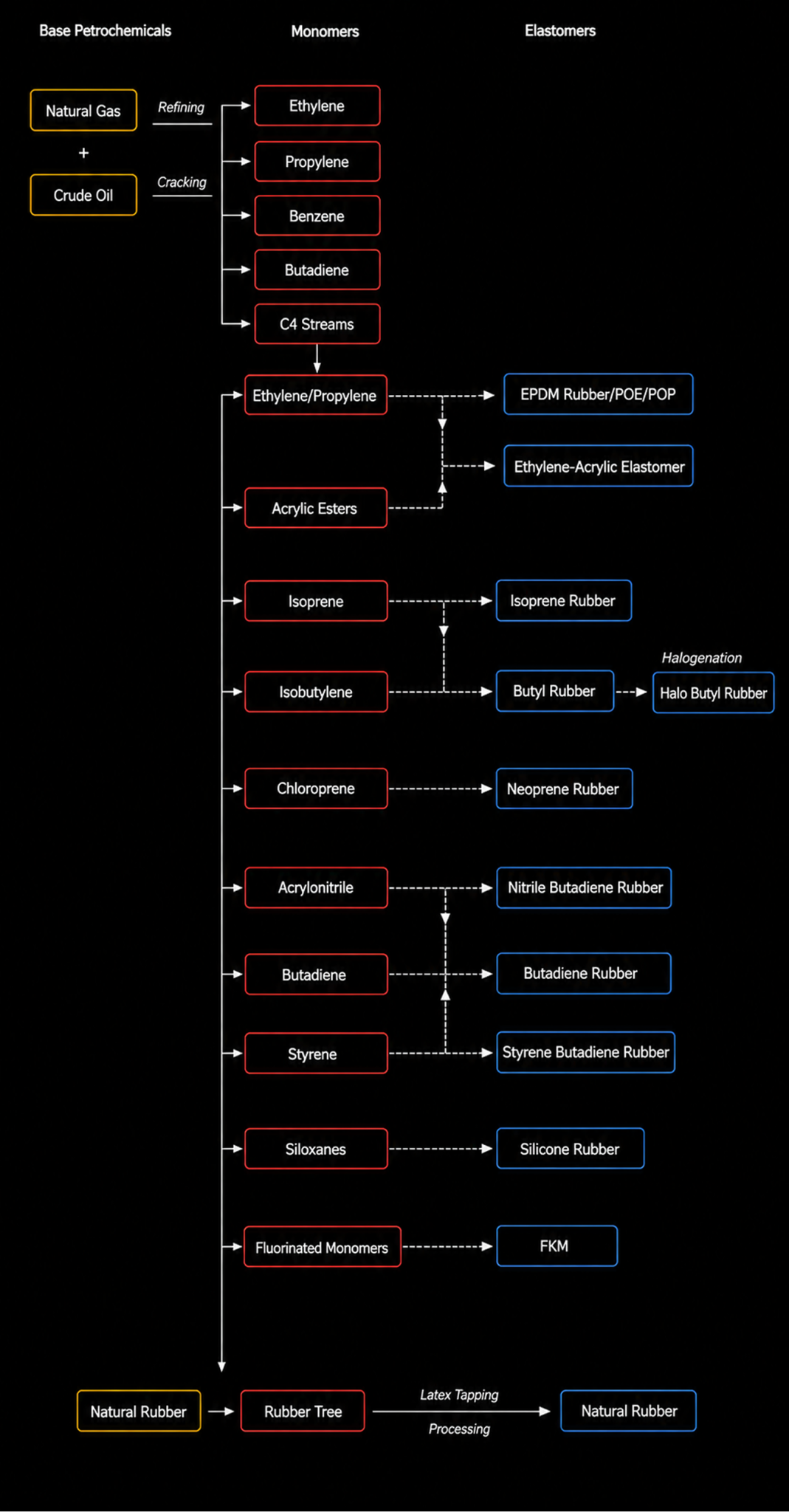
We assess prices across the full elastomers complex, the backbone of global automotive, industrial, and consumer manufacturing. Natural Rubber. SBR. BR. EPDM. NBR. Neoprene. Silicone Rubber. Every elastomer grade and feedstock that moves markets, assessed across every region that matters.
GEOGRAPHIC REACH
Every region that trades.
Every hub that matters.
An FOB price out of South Korea tells a different story than a CIF price into China. With arbitrage windows shifting rapidly, our assessments provide coverage across major origins, destinations, and trade routes in the global elastomers market.
WHO USES OUR DATA
Every link in the chain.
Every stakeholder that matters.
From Monomers producers to Tyre manufacturers, every participant in the elastomers value chain depends on accurate pricing.
The numbers are only as good as the method behind them.
Access our fertilizer price assessments and insights in the format that works best for you. Easy to integrate. Easy to use.
Our team of analysts gather real bids, offers, and confirmed deals from producers, traders, and end-buyers, every market day.
Each assessment is normalised for grade, specification, and delivery basis before publication.
The methodology is published, auditable, and independent of any commercial interest.
Our Assessment Process
Transactions, not models
Every price is anchored to actual market activity. We collect real bids, offers, and confirmed trades to derive assessments. Data from from market participants is validated by our analysts before use.
No one owns the number
Cut analyst/reporter bias from commercial decisions. Our structure ensures no individual, firm, or institution can influence or own a price assessment.
Annual independence audits
No preferential access for any participant
A consensus-driven output
Analysts
No single analyst controls the final number
No global firm
No preferential access for any market participant
Financial firm
Institutions cannot influence assessments
A consensus
Output of a structured, rules-based methodology
Same window, every time
Price assessed at a fixed weekly moment, citing the same reference to contract prices. Every assessment uses the same daily close window, providing a consistent and comparable benchmark across markets and time.
Weekly Close Window Info
Audit it yourself
Methodology, transparency, and validity tools — access unique reference links, validate our analysis process, and verify our work end-to-end.
Price methodology
User-assessed
tools
Fully auditable
DATA ACCESS
Fits how your team already works.
Access our fertilizer price assessments and insights in the format that works best for you. Easy to integrate. Easy to use.
Timely Weekly updates you can rely on.
Secure Enterprise-grade security & controls.
Flexible Multiple formats. One data source.
Excel Add-in
Live prices in your spreadsheet. Refresh on demand.
REST API
JSON feed with full history and real-time updates.
CSV / SFTP
Scheduled data drops direct to your systems.
Web Platform
Browser-based dashboard — no install required.
Fits how your team already works.
API feeds for trading and ERP systems. An online platform for analysts. Excel/CSV exports for procurement. One subscription. Every forma